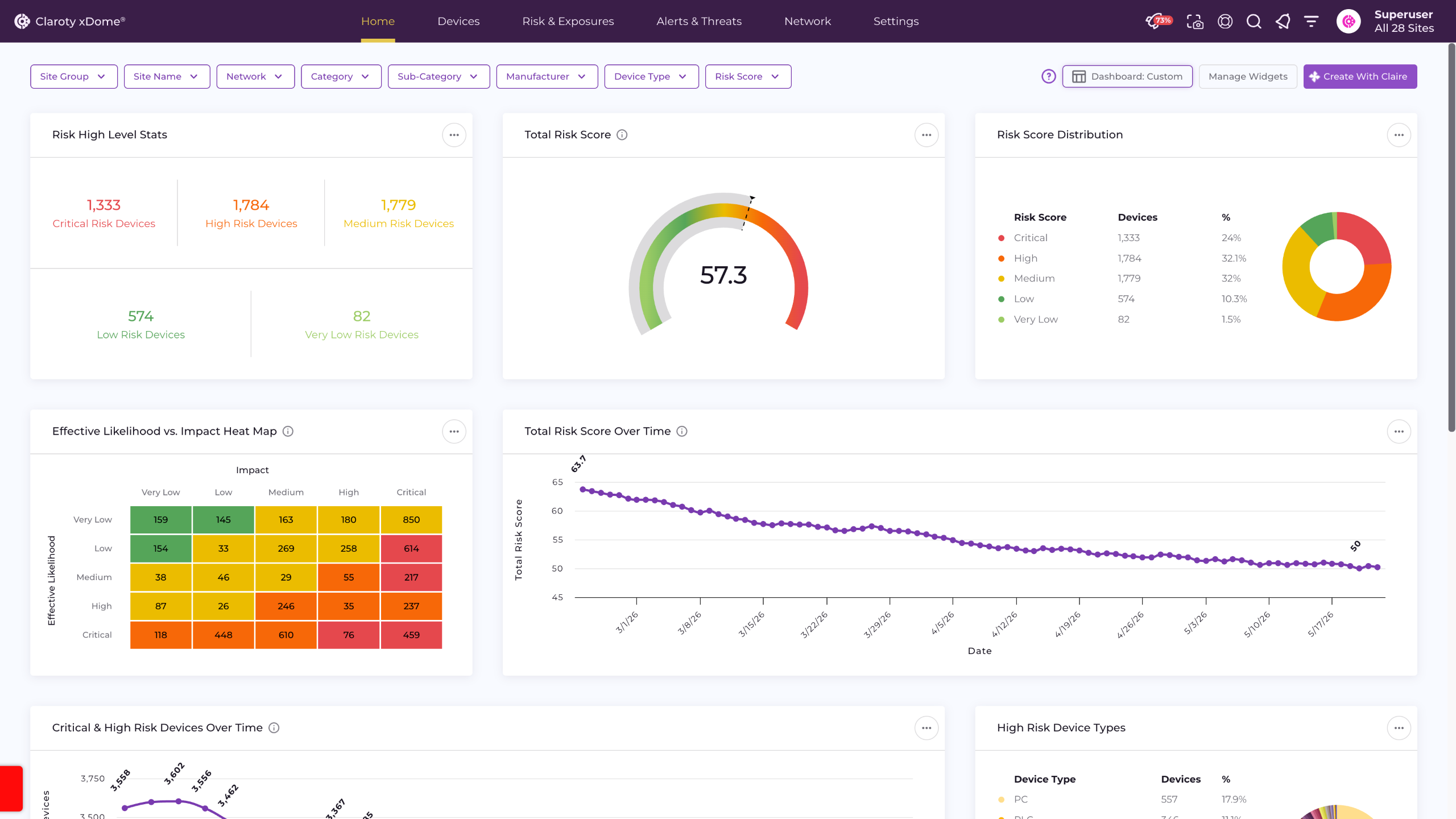

Cyber-physical systems (CPS) are the most overlooked risk in operational technology (OT) and internet of medical things (IoMT) audits. Use the NCSC Secure Connectivity Principles to master the journey toward operational resilience and full compliance.
See how Claroty xDome moves you beyond basic perimeter defence to implement the NCSC Secure Connectivity Principles.
The regulatory landscape has fundamentally changed for UK Critical National Infrastructure (CNI), ending the era of IT-only security. For responsible entities managing OT and IoMT, the stakes are now at a national level.
Financially, non-adherence creates a triple-threat of regulatory fines, lost revenue, and high insurance costs.
Fines up to £17.5 Million or 4% of global turnover for CNI
The trend in 2026 is individual accountability. Security is no longer just the IT guy's problem; it is a boardroom obligation.
Personal executive liability and criminal charges for gross negligence
Why?
Under the Cyber Security and Resilience Bill (2025/26), regulators have increased powers to issue GDPR-style turnover-based fines for serious breaches.
If it is proven that the board ignored NCSC guidance or failed to report the incident within the mandatory 24-hour window.
Align people, processes, and technology to bridge the CPS gap for NCSC adherence.
The NCSC mandates an accurate, definitive view of OT architecture. Yet, 88% of CPS assets fail to transmit exact product codes, and 76% use names that differ from official records. Without a verified identity, security teams are left with partial CVE matches and imprecise risk scores.
Solution: The CPS Library
Automatically translate messy naming strings into a verified global standard.
Standard IT tools see less than 5% of CPS assets. Claroty provides 99% detection accuracy, delivering the single source of truth required for NCSC and Cyber Assessment Framework (CAF) audits.
The NCSC CAF requires appropriate and proportionate risk management. Treating every PLC the same creates noise, not security. The biggest breach of duty of care isn’t an unpatched device, it’s the failure to protect the business processes and patient safety systems that save lives.
Solution: Device Purpose
Move from seeing a generic device to identifying a mission-critical asset in a high-priority operational zone.
Automatically group assets by business criticality to ensure remediation efforts protect national interest and safety.
Recent legislation places accountability directly at the executive level. Boards need business answers, not technical spreadsheets. You need to bridge the gap between technical OT/IoMT data and executive language instantly.
Solution: MCP Server
Bridge the gap between technical data and business risk by asking natural language questions like: "Which high-impact assets are most vulnerable?"
Generate customisable, NCSC-aligned compliance reports in seconds, translating CPS data into audit-ready evidence.
UK organisations often mistakenly apply standard IT security controls to their corporate environment while overlooking the unique requirements of CPS.
Traditional Corporate IT
Cyber-Physical Systems (CPS)
Frequent refreshes (3–5 years).
Decades-old legacy devices never designed for modern internet connectivity or security requirements.
Scheduled maintenance is standard.
Shutting down for hours is economically and physically unfeasible.
Standard discovery tools work well.
Use of proprietary/legacy protocols creates blind spots for standard IT tools.
Software agents are easily deployed.
Inability to deploy agents on legacy systems; requires passive scanning to avoid disruption.
Rapid deployment of updates.
Patches may require OEM low-level access, potentially opening new attack vectors.
Data confidentiality and integrity.
Safety, uptime, and reliability of physical processes.
Pro Tip!
When 24/7 uptime prevents traditional patching, operational cyber risk platforms provide compensating controls recognised by the NCSC and global standards like ISA/IEC 62443 as valid compliance alternatives.
Move from technical silos to a shared language that boards understand, protecting executives from personal liability and preventing career-ending reputational damage.
Stop chasing low-priority alerts. Use verticalised hierarchies to know exactly what to fix and who owns the asset.
Gain the documented evidence required for Cyber Assessment Framework (CAF) audits aligned with NCSC guidelines and global standards like ISA/IEC 62443.
Eliminate manual inventory and prevent downtime during security updates.
Ensure IoMT assets remain secure without interrupting clinical workflows, providing the required data for mandatory asset registration.
Technology is only half the battle. Download the full NCSC alignment whitepaper to align your people, processes, and technology with UK Critical National Infrastructure requirements.
Want to see how Claroty will support your entire CPS cybersecurity journey?